Base has surpassed Solana in daily token launches, driven by a boom in creator coins minted from social posts on the Base app. But with most of the activity driven by short-term traders, the question now is whether this new…Base has surpassed Solana in daily token launches, driven by a boom in creator coins minted from social posts on the Base app. But with most of the activity driven by short-term traders, the question now is whether this new…

Zora’s creator coins push Base past Solana in daily token launches — but will it last?

2025/08/04 19:14
3 min read
For feedback or concerns regarding this content, please contact us at crypto.news@mexc.com

Base has surpassed Solana in daily token launches, driven by a boom in creator coins minted from social posts on the Base app. But with most of the activity driven by short-term traders, the question now is whether this new creator economy can last.

Summary
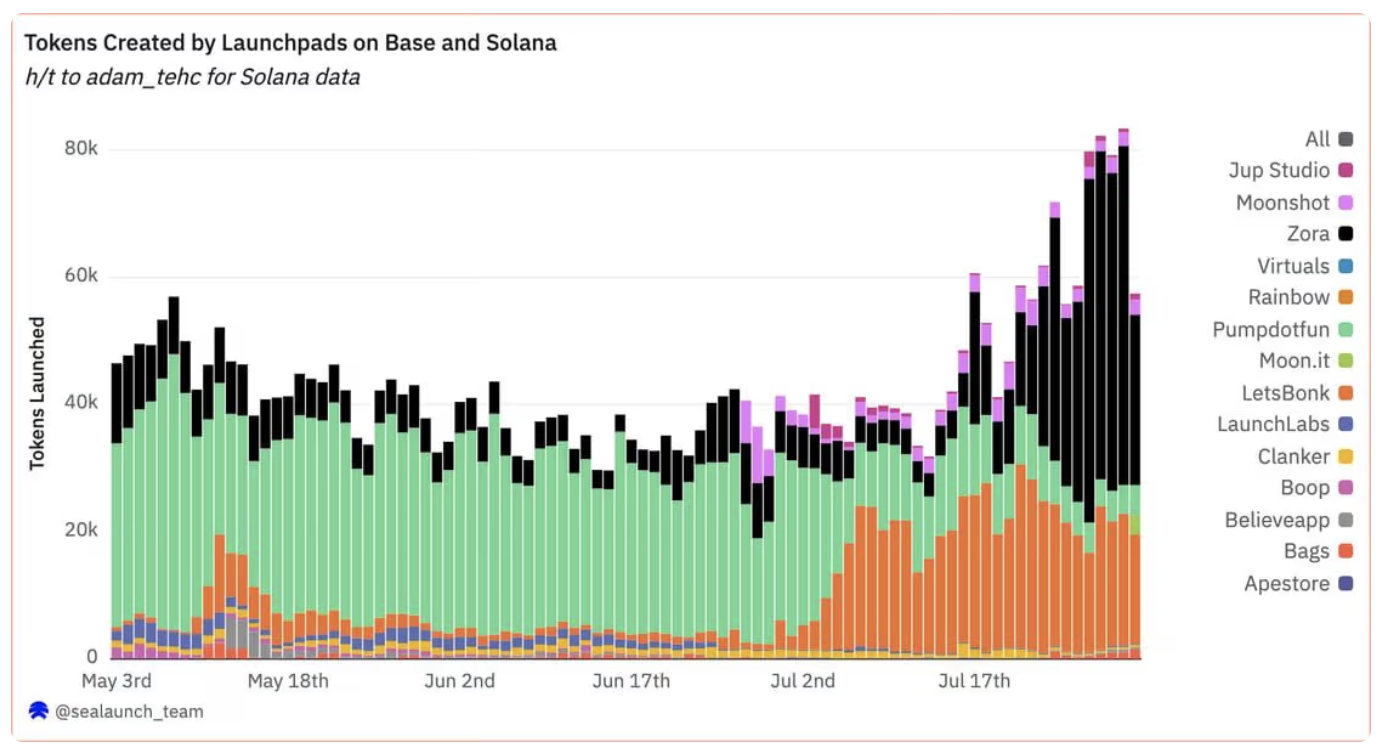
  • Base has surpassed Solana in daily token launches, driven by “creator coins” minted automatically by Zora’s smart contracts whenever users post social content on the Base app (formerly Coinbase Wallet).
  • Over 1.6M tokens launched and nearly 3M traders active within weeks, generating $470 million in trading volume.
  • Leading creator coins by market cap include Zeebu ($487.9M), Wormhole ($355.8M), and Zora ($205.3M), with Zora also dominating in trading volume at $102.8M daily.

The Ethereum (ETH) Layer 2 network Base, developed by Coinbase, has just surpassed Solana (SOL) in daily token launches.
Zora’s creator coins push Base past Solana in daily token launches — but will it last? - 1

This was largely driven by a powerful new mechanism that turns social content into tradable tokens. Each time a user posts on the Base app, Zora’s smart contracts automatically mint an ERC-20 token linked to that piece of content. This token or “creator coin” is then launched on Base and becomes instantly tradable. The original creator then receives a portion of the supply and earns fees every time the token is traded, turning every post into a potential revenue stream.

This new creator economy has led to over 1.6 million tokens launched and nearly 3 million traders participating, generating around $470 million in trading volume since the Base app relaunch. The flagship ZORA token itself now boasts a market cap of around $200 million—an increase of approximately 185% from its ~$70 million valuation in April. It peaked at about $310 million in late July before retracing to current levels.

Other notable creator coins on Base have also achieved substantial market caps and are driving substantial trading volumes, including:

  • Zeebu (ZBU), with a market cap of $487.9 million, though daily trading remains relatively light at $371K—suggesting strong valuation but limited liquidity.
  • Wormhole (W) follows closely, boasting a $355.8 million market cap and a healthy $22.6 million in 24-hour volume, making it one of the more actively traded tokens in the ecosystem.
  • Yield Guild Games (YGG) holds a $81.3 million market cap and sees $12 million in daily volume.
  • Zentry (ZENT) rounds out the group with a $54 million valuation and $6.7 million in 24-hour volume.

For context, the Base app, which has served as a user-friendly front end to the Zora’s creator token ecosystem, was rebranded from Coinbase Wallet in mid-July. It’s now a comprehensive SocialFi platform that combines social networking (powered by Farcaster), USD Coin (USDC) payments, onchain identity management, and dApp discovery.

Are Zora’s creator coins on Base more than a hype cycle?

Despite the rapid growth in these creator coins, much of the activity is driven by short-term traders who are after quick profits, which isn’t sustainable. To address this, Jesse Pollak, the creator of Base, has suggested that crypto funds step up by taking sizable, long-term positions—such as $5 million or more— in creator coin indexes, calling this a “a relatively no-brainer opportunity to win as the onchain creator economy grows.”

Market Opportunity
TokenFi Logo
TokenFi Price(TOKEN)
$0.002833
$0.002833$0.002833
0.00%
USD
TokenFi (TOKEN) Live Price Chart
Disclaimer: The articles reposted on this site are sourced from public platforms and are provided for informational purposes only. They do not necessarily reflect the views of MEXC. All rights remain with the original authors. If you believe any content infringes on third-party rights, please contact crypto.news@mexc.com for removal. MEXC makes no guarantees regarding the accuracy, completeness, or timeliness of the content and is not responsible for any actions taken based on the information provided. The content does not constitute financial, legal, or other professional advice, nor should it be considered a recommendation or endorsement by MEXC.

You May Also Like

Shocking OpenVPP Partnership Claim Draws Urgent Scrutiny

Shocking OpenVPP Partnership Claim Draws Urgent Scrutiny

The post Shocking OpenVPP Partnership Claim Draws Urgent Scrutiny appeared on BitcoinEthereumNews.com. The cryptocurrency world is buzzing with a recent controversy surrounding a bold OpenVPP partnership claim. This week, OpenVPP (OVPP) announced what it presented as a significant collaboration with the U.S. government in the innovative field of energy tokenization. However, this claim quickly drew the sharp eye of on-chain analyst ZachXBT, who highlighted a swift and official rebuttal that has sent ripples through the digital asset community. What Sparked the OpenVPP Partnership Claim Controversy? The core of the issue revolves around OpenVPP’s assertion of a U.S. government partnership. This kind of collaboration would typically be a monumental endorsement for any private cryptocurrency project, especially given the current regulatory climate. Such a partnership could signify a new era of mainstream adoption and legitimacy for energy tokenization initiatives. OpenVPP initially claimed cooperation with the U.S. government. This alleged partnership was said to be in the domain of energy tokenization. The announcement generated considerable interest and discussion online. ZachXBT, known for his diligent on-chain investigations, was quick to flag the development. He brought attention to the fact that U.S. Securities and Exchange Commission (SEC) Commissioner Hester Peirce had directly addressed the OpenVPP partnership claim. Her response, delivered within hours, was unequivocal and starkly contradicted OpenVPP’s narrative. How Did Regulatory Authorities Respond to the OpenVPP Partnership Claim? Commissioner Hester Peirce’s statement was a crucial turning point in this unfolding story. She clearly stated that the SEC, as an agency, does not engage in partnerships with private cryptocurrency projects. This response effectively dismantled the credibility of OpenVPP’s initial announcement regarding their supposed government collaboration. Peirce’s swift clarification underscores a fundamental principle of regulatory bodies: maintaining impartiality and avoiding endorsements of private entities. Her statement serves as a vital reminder to the crypto community about the official stance of government agencies concerning private ventures. Moreover, ZachXBT’s analysis…
Share
BitcoinEthereumNews2025/09/18 02:13
White House ballroom architect speaks out against Trump immigration policies

White House ballroom architect speaks out against Trump immigration policies

Shalom Baranes, a Libyan refugee and chief architect for President Donald Trump’s White House ballroom project, described the president’s immigration policies as
Share
Rawstory2026/03/22 00:47
Longtime Republican laments the GOP collapse into the 'gutter'

Longtime Republican laments the GOP collapse into the 'gutter'

Republican strategist Steve Schmidt says he’s been a Republican for nearly 30 years, long enough to see it’s sad “devolution” over the last few.“Yesterday, was
Share
Alternet2026/03/21 23:54